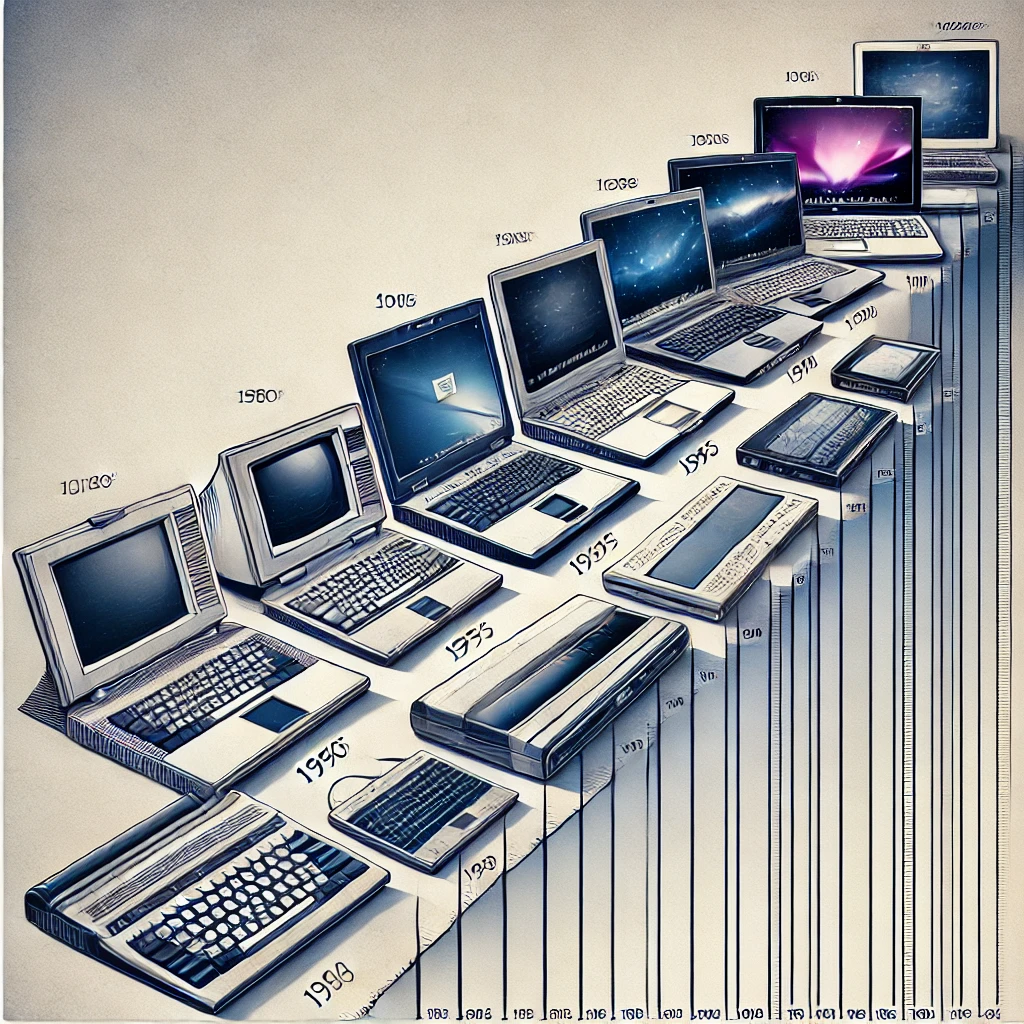
The laptop you use today is the product of four decades of relentless iteration, miniaturization, and market experimentation. From 24-pound suitcase machines to sub-kilogram ultrabooks, the evolution of portable computing reflects broader shifts in semiconductor design, battery chemistry, wireless standards, and enterprise procurement. Understanding this history helps buyers appreciate why certain form factors endure, why business-class models hold value longer, and how refurbishment fits into the lifecycle of professional-grade hardware.
At Edify, we process over 5,000 refurbished units per month through our Sarjapur Road facility in Bengaluru—having served 50,000+ customers across India’s 1,800+ pin codes since our inception—and the majority are enterprise models from the ThinkPad, Latitude, and EliteBook families. These machines inherit design DNA from the earliest portable computers, and their durability is no accident. It’s the result of decades of engineering lessons learned in the field. This post traces that journey and explains why today’s refurbished business laptops offer exceptional value for students, professionals, and small businesses across India’s 1,800+ pin codes.
The Osborne 1 and the Birth of Portable Computing
| Rank | Model | CPU | RAM | SSD | Display | Price (₹) | Best For | Rating |
|---|---|---|---|---|---|---|---|---|
| 1 | Lenovo ThinkPad E14 (10th Gen) | Intel Core i5-10210U | 8GB DDR4 | 256GB SSD | 14-inch FHD (1920×1080) | ₹24,500 | Students, Office Work | ★★★★★ |
| 2 | Dell Latitude 5410 | Intel Core i5-10300H | 8GB DDR4 | 512GB SSD | 14-inch FHD (1920×1080) | ₹26,999 | Professionals, Business | ★★★★★ |
| 3 | HP EliteBook 840 G7 | Intel Core i7-10510U | 16GB DDR4 | 512GB SSD | 14-inch FHD (1920×1080) | ₹32,500 | Content Creation, Multitasking | ★★★★★ |
| 4 | Lenovo ThinkPad T490s | Intel Core i7-8565U | 16GB DDR4 | 512GB SSD | 14-inch FHD (1920×1080) | ₹35,900 | Enterprise, Video Editing | ★★★★★ |
| 5 | MacBook Air (2015) | Intel Core i5-5250U | 8GB LPDDR3 | Lenovo ThinkPad T490 with Intel Core i7 8th Gen at ₹27,060 remain popular in the refurbished segment. The combination of proven battery chemistry and enterprise-grade power management means these machines can serve a second or even third owner without significant performance loss.
The Intel Centrino Era and Wireless ConnectivityThe Intel Centrino platform revolutionized laptops by integrating wireless connectivity directly into processor architecture, launching the mobile computing era in 2003. Centrino combined Intel’s Pentium M processor with the Intel PRO/Wireless 2100 802.11b card, delivering unprecedented battery life of up to 5 hours while eliminating the need for bulky external wireless modules. This innovation transformed business laptops into truly untethered machines, enabling professionals to work from coffee shops, airports, and client offices without degradation in performance or connectivity. The Centrino brand became synonymous with premium mobile computing, commanding price premiums that helped establish the business-class laptop segment. Many refurbished ThinkPad and Latitude models from this era retain full Centrino specifications and remain dependable for remote work today through Edify.club’s curated inventory. In March 2003, Intel launched the Centrino mobile platform, bundling the Pentium M processor, Intel 855 chipset, and an integrated Wi-Fi module. Centrino was the first x86 platform designed from the ground up for mobile use, with aggressive power gating, dynamic frequency scaling, and a thermal envelope under 25 watts. Laptops bearing the Centrino logo promised all-day battery life and built-in wireless, a combination that accelerated the shift from wired desktops to wireless notebooks in both consumer and enterprise segments. The Pentium M’s microarchitecture drew on lessons from the Pentium III rather than the power-hungry Pentium 4, prioritizing instructions-per-clock over raw frequency. This approach delivered better performance-per-watt, a metric that has dominated mobile processor design ever since. By 2006, Intel had transitioned to the Core brand (Core Duo, Core 2 Duo), and the multi-core era began. Dual-core processors enabled true multitasking without the thermal penalties of earlier high-frequency designs, and laptops became viable replacements for desktop workstations in many roles. Wi-Fi integration also changed the laptop value proposition. Before Centrino, wireless adapters were often PCMCIA cards or USB dongles, adding cost and complexity. Centrino’s integrated 802.11b (and later 802.11g and 802.11n) meant that every laptop could connect to corporate networks and home broadband out of the box. This ubiquity drove demand for business laptops in education, healthcare, and small business, sectors that now form the core of the refurbished market. A certified second-hand laptop from 2018 or later typically includes 802.11ac Wi-Fi and Bluetooth 4.2 or higher, standards that remain adequate for most use cases in 2026. Ultrabooks, MacBook Air, and the Thin RevolutionThe thin revolution began in earnest with the Ultrabook category, launched by Intel in 2011 to compete with Apple’s MacBook Air. These machines redefined portable computing by combining sub-15mm thickness with full processing power, abandoning the bulky designs that dominated the 2000s. The original MacBook Air, released in 2008, set the standard with its aluminum unibody construction and 1.6kg weight, proving that professionals would embrace thinner laptops without sacrificing performance. Today’s ultrabooks weigh under 1kg and cost between ₹60,000 and ₹2,00,000, depending on specifications. This design philosophy permanently shifted expectations: portability became non-negotiable, not premium. The enterprise models refurbished by Edify inherit this DNA, delivering the same thin-and-light philosophy at sustainable price points. Apple’s MacBook Air, introduced in January 2008, redefined expectations for laptop thickness and weight. At 0.76 inches at its thickest point and 3 pounds, the Air proved that a full-function laptop could fit in a manila envelope. It achieved this through aggressive component integration (soldered RAM, custom SSD), a unibody aluminum chassis, and a willingness to omit legacy ports (optical drive, Ethernet). The Air’s success forced the industry to rethink the trade-offs between expandability and portability. Intel responded in 2011 with the Ultrabook specification, requiring devices to be under 0.8 inches thick, boot in under seven seconds (via SSD), and deliver five-plus hours of battery life. Ultrabooks adopted many Air design cues (aluminum or magnesium chassis, soldered components, NVMe SSDs) but retained Windows and often included touchscreens. The Dell XPS 13, Lenovo Yoga, and HP Spectre became flagship Ultrabooks, and their trickle-down effect raised build quality across the entire laptop market. For the refurbished segment, the Ultrabook era had mixed effects. Soldered RAM and proprietary SSDs reduced upgrade and repair options, shortening the practical lifespan of some models. However, the emphasis on premium materials and rigorous testing meant that Ultrabooks from 2015 onward often remain in excellent cosmetic and functional condition after five years. At Edify, we see strong demand for refurbished Ultrabooks in the ₹35,000 to ₹45,000 range, particularly from buyers who want lightweight travel machines but cannot justify new flagship pricing. Models like the Dell Latitude 5420 with Intel Core i5 11th Gen at ₹36,699 blend Ultrabook-class portability with business-grade durability and serviceability. Modern Laptops and the Refurbishment OpportunityModern business laptops represent the pinnacle of four decades of portable computing evolution, making them ideal candidates for refurbishment and resale. The ThinkPad, Latitude, and EliteBook lineages—which dominate Edify’s processing of 5,000+ units monthly—inherit robust engineering standards developed through decades of field testing and real-world iteration. These enterprise-class machines are built with durable components, modular designs, and longer product lifecycles than consumer models, allowing them to withstand multiple ownership cycles without performance degradation. A refurbished business-class laptop typically costs 40-60% less than new while delivering equivalent functionality for professional work, making refurbishment economically sensible for students, small businesses, and professionals across India. Edify’s Bengaluru facility certifies each unit to ensure quality parity with original specifications. Today’s laptop market is defined by incremental refinement rather than revolutionary leaps. Processors from Intel’s 8th Gen onward and AMD’s Ryzen 3000 series onward deliver performance that exceeds the needs of most office, education, and light creative workloads. Displays have standardized on 1080p IPS panels with good color accuracy. SSDs have replaced hard drives almost entirely, and USB-C with Power Delivery is becoming universal. These plateaus mean that a well-specified laptop from 2018 or 2019 can serve the same roles as a new entry-level machine in 2026, often with better build quality and keyboard feel. This performance plateau is the economic foundation of the refurbished laptop market. When a three-year-old ThinkPad T490 offers an Intel Core i5 8th Gen processor, 32GB RAM, a 512GB NVMe SSD, and a 14-inch FHD display for ₹34,900, it competes directly with new consumer laptops at similar price points but delivers superior durability, repairability, and input quality. The T490’s magnesium-reinforced chassis, spill-resistant keyboard, and MIL-STD-810G testing are features typically reserved for machines costing ₹60,000 or more when new. Refurbishment also addresses the environmental cost of laptop production. Manufacturing a new laptop generates approximately 200 to 300 kilograms of CO₂-equivalent emissions, with the majority coming from component fabrication and assembly. Extending a laptop’s useful life by three to five years through refurbishment avoids those emissions and reduces e-waste. Edify’s CheckMate process includes 50-plus diagnostic tests covering battery health, hinge integrity, keyboard function, display uniformity, and thermal performance, ensuring that every certified unit meets the same functional standards as new inventory. This combination of economic value and environmental responsibility resonates with buyers across India’s 1,800+ pin codes, from metro students to small-town entrepreneurs. Why Laptop Evolution Matters for Today’s BuyersUnderstanding laptop evolution directly impacts your purchasing decisions and long-term value. Four decades of refinement transformed 24-pound suitcase computers into sub-kilogram ultrabooks, teaching manufacturers critical lessons about durability, thermal management, and component reliability. The business-class models you see today inherit design DNA from the Osborne 1 and its successors, which explains why ThinkPads, Latitudes, and EliteBooks command premium prices and retain value longer than consumer alternatives. When the Osborne 1 launched at $1,795 in 1981, it proved professionals would pay for portability and quality. Modern refurbished business laptops deliver that same engineering excellence without the premium markup, processing over 5,000 units monthly through our Bengaluru facility demonstrates why these heritage designs remain the foundation of professional computing across India. Understanding laptop history helps buyers make smarter purchasing decisions. The design choices that made the ThinkPad 700C a success in 1992 (modular construction, rigorous testing, excellent keyboard) are the same choices that make a 2019 ThinkPad T14 a strong refurbished buy in 2026. The shift to Li-ion batteries in the late 1990s established the chemistry and charge-management practices that keep refurbished batteries viable today. The Centrino platform’s focus on performance-per-watt laid the groundwork for the efficient multi-core processors that power modern productivity work. For buyers evaluating Dell laptop pricing or HP laptop pricing, historical context clarifies why certain models command higher resale values. Business-class machines from the Latitude, EliteBook, and ThinkPad lines were engineered for multi-year enterprise deployments, with parts availability, driver support, and build quality to match. Consumer models, even from the same manufacturers, often use plastic chassis, lower-grade displays, and shorter support lifecycles. These differences compound over time, making business-class refurbs a better long-term investment. The evolution of laptop design also explains why certain form factors persist. The 14-inch clamshell with a centered keyboard and pointing device remains the dominant business laptop layout because it balances portability, usability, and thermal management. Convertibles and detachables have carved out niches, but the traditional clamshell accounts for the majority of enterprise procurement and, by extension, the majority of refurbished inventory. At Edify, 14-inch models represent over 60 percent of our catalog, reflecting both corporate buying patterns and user preference for a proven form factor. Finally, laptop history underscores the importance of standards and interoperability. The shift from proprietary power connectors to USB-C Power Delivery, from mini-PCIe Wi-Fi to M.2, and from SATA to NVMe has made laptops easier to service and upgrade. A refurbished laptop with USB-C charging can use the same adapter as a smartphone or tablet, reducing cable clutter and replacement costs. An M.2 NVMe slot allows storage upgrades at commodity prices. These standards-driven improvements mean that a refurbished laptop from 2019 can integrate seamlessly into a 2026 workflow, with no compatibility penalties. For students, the lesson is clear: a refurbished business laptop offers better build quality, longer support, and superior input devices than a new consumer model at the same price. For small businesses, the historical durability of ThinkPad and Latitude models translates into lower total cost of ownership and fewer support calls. For gamers on a budget, understanding the evolution of discrete GPUs and cooling systems helps identify which older models can still handle esports titles and light gaming workloads. Trivia Highlights from Four Decades of Laptops
How Edify Applies Historical Lessons to RefurbishmentAt Edify, we apply the same engineering rigor that defined early ThinkPad development to our refurbishment process. CheckMate, our proprietary AI-driven quality system, runs over 50 diagnostic tests on every unit, covering battery cycle count, hinge torque, keyboard actuation force, display brightness uniformity, and thermal throttling under load. Units that fail any test are routed for component-level repair or parts harvesting, ensuring that only fully functional machines reach customers. We also prioritize models with proven longevity. The Lenovo ThinkPad with Intel Core i5 8th Gen at ₹28,699 is one of our best-sellers, with 1,966 units sold, because it inherits the T-series design DNA that has made ThinkPads the benchmark for business portables since 1992. The Dell Latitude 7490 with Intel Core i5 8th Gen at ₹28,500 offers similar durability and performance, with Dell’s enterprise support legacy ensuring parts availability and driver updates for years to come. Our inventory spans 1,800+ pin codes across India, from metro hubs to tier-2 and tier-3 cities. This geographic reach reflects the democratizing effect of refurbishment: a student in Jaipur or a small business in Coimbatore can access the same enterprise-grade hardware that once served Fortune 500 companies, at prices that fit local budgets. The laptop’s evolution from a $10,000 executive tool to a sub-₹30,000 productivity essential is mirrored in the refurbished market’s ability to deliver high-quality hardware at accessible price points. Every laptop we certify carries a 12-month warranty and has been tested to the same standards we would apply to our own equipment. This commitment to quality is rooted in the same principles that guided IBM’s Yamato Labs in the 1990s: build for the long term, test rigorously, and never compromise on the fundamentals. The result is a catalog of over 5,000 units per month that meet the needs of India’s diverse buyer base, from college students to corporate procurement teams. The history of the laptop is a history of trade-offs: portability versus performance, battery life versus weight, cost versus durability. Understanding those trade-offs helps buyers navigate today’s market with confidence, whether they’re choosing between a new consumer model and a refurbished business machine, or deciding which processor generation offers the best value. At Edify, we believe that informed buyers make better decisions, and that the lessons of four decades of laptop evolution remain relevant every time someone clicks ‘add to cart’ on a certified refurbished ThinkPad or Latitude. Researched and drafted with AI assistance, then reviewed by Saurabh Vyas, Co-Founder & Chief Operating Officer at Edify.club.
|


No Comments
Leave a comment Cancel